You do not need a complicated meal plan to eat for hormone balance. You need one formula that works for every meal, every day, regardless of your schedule. Here is exactly what it is and why each component matters.
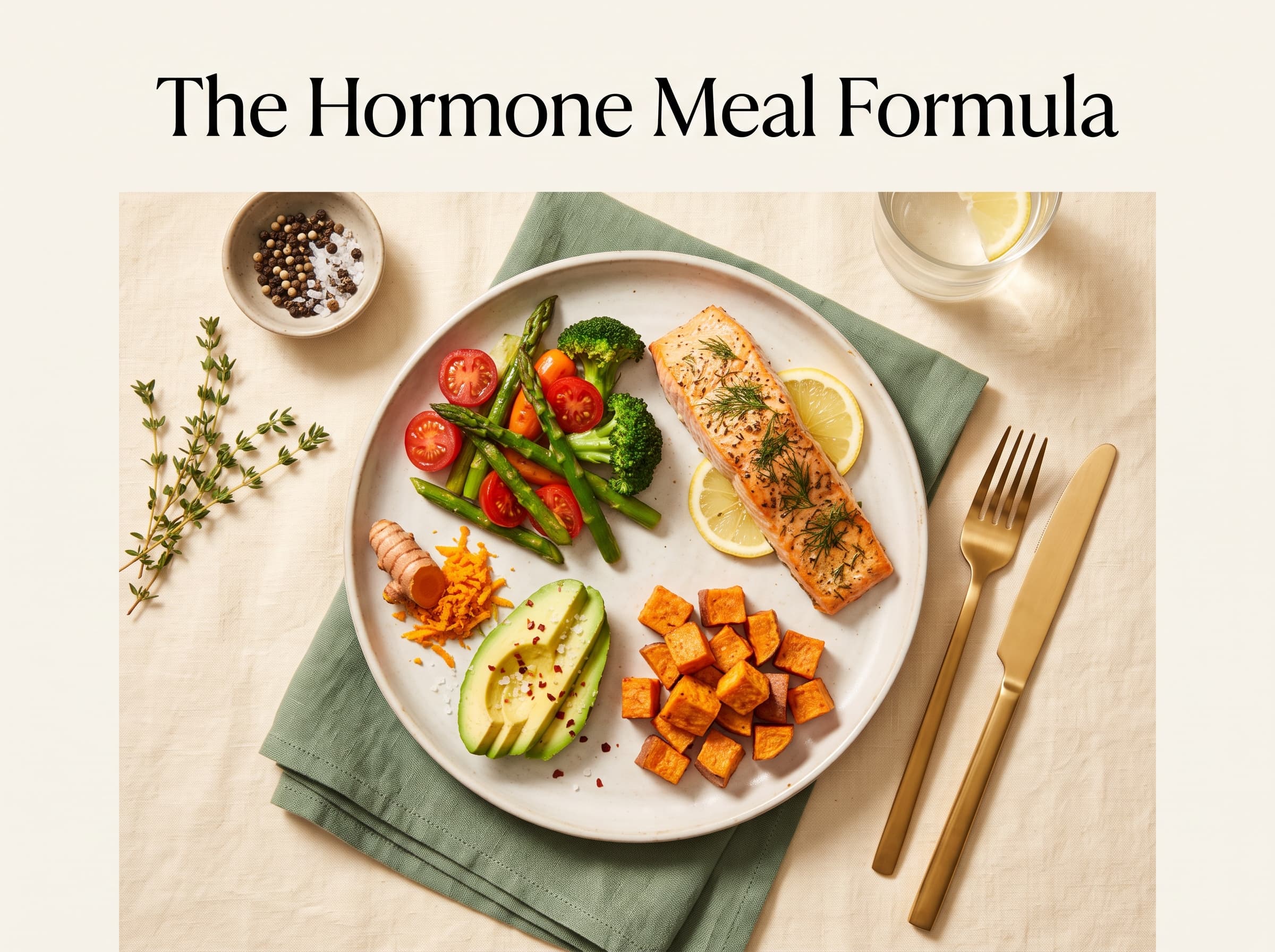
The Hormone-Friendly Meal Formula Every Busy Woman Needs to Know
Most hormone health content makes eating for hormone balance sound like a full-time job. Cycle syncing every meal. Tracking specific nutrients per phase. Researching which supplement to add to which deficiency. Maintaining a food diary across an app.
For women with full lives, this level of complexity is not a path to better hormone health. It is a path to deciding that eating for hormone balance is not something they have time for and returning to whatever they were doing before.
There is a simpler way, and it is actually more effective for most women than the elaborate protocols, because it can be sustained consistently over months, which is the only timescale on which hormonal change becomes meaningful.
Here is the formula.
The Five-Component Hormone Meal Formula
Every meal that supports hormone balance needs five things. You do not need to count them or track them. You need to build the habit of including them.
Component 1: A Protein Source (25-35 grams)
Protein is not optional in a hormone-supportive meal. It serves three essential functions simultaneously.
First, it provides the amino acid building blocks from which peptide hormones and neurotransmitters are synthesized. You cannot make adequate amounts of the hormones your body requires without adequate amino acid availability from dietary protein.
Second, it anchors blood sugar. Protein produces the lowest insulin response of any macronutrient and blunts the glucose spike from any carbohydrates consumed alongside it. Blood sugar stability is the foundation of cortisol regulation, and cortisol regulation is the foundation of every downstream hormone.
Third, it supports muscle protein synthesis, which is relevant for hormone health in a specific way: muscle tissue is one of the primary sites of insulin-mediated glucose uptake. More muscle means better insulin sensitivity, which means lower insulin at baseline, which means less of the fat-storing, inflammation-driving, estrogen-amplifying hormonal environment that chronically elevated insulin creates.
Sources: wild salmon, sardines, grass-fed beef, organic chicken, pastured eggs, plain Greek yogurt, kefir. The animal proteins have higher biological value than most plant proteins and provide the leucine threshold (approximately 2.5-3 grams per meal) needed to meaningfully activate muscle protein synthesis.
Component 2: Two Handfuls of Colorful Vegetables
The vegetable component in a hormone-supportive meal is doing multiple things simultaneously, which is why volume matters.
Fiber slows the glucose absorption from any carbohydrates consumed at the meal, further blunting the insulin spike. Cruciferous vegetables specifically provide glucosinolates and DIM (diindolylmethane) that support liver estrogen metabolism through all three phases of liver detoxification. Leafy greens provide magnesium, the mineral required for progesterone synthesis, cortisol regulation, and sleep quality. Diverse colorful vegetables provide polyphenols that feed the gut bacteria comprising the estrobolome, the gut microbiome component governing estrogen metabolism.
Two handfuls means roughly half a plate. This is not a small side salad. It is the dominant component of the meal by volume.
The variety principle: try not to eat the same three vegetables daily. Microbiome diversity is built through dietary variety. Different plants feed different bacterial species. Rotating through eight to twelve different vegetables across the week is meaningfully better for the estrobolome than eating spinach and broccoli every day.
Component 3: One Tablespoon of Healthy Fat
Steroid hormones, which include estrogen, progesterone, testosterone, and cortisol, are synthesized from cholesterol. Cholesterol is a fat-derived molecule. Without adequate dietary fat, the raw material for steroid hormone production is limited.
Fat also serves as the absorption vehicle for fat-soluble vitamins including vitamins D, K2, A, and E, all of which play direct roles in hormone production and receptor function. A meal with significant vegetable content and no fat source is absorbing a fraction of the fat-soluble nutrients those vegetables provide.
Healthy fat also further slows gastric emptying, extending the blood sugar stabilizing effect of the meal and reducing the cortisol response to any carbohydrates consumed.
Sources: extra virgin olive oil (one tablespoon drizzled over finished meals), avocado (half), pastured butter or ghee (one teaspoon for cooking), fatty fish (which provides both protein and fat), a small handful of walnuts or pumpkin seeds.
Component 4: A Complex Carbohydrate (In Appropriate Context)
Carbohydrates are not the enemy of hormone balance. Severe carbohydrate restriction is actually a hormonal stressor: it elevates cortisol, suppresses T3 thyroid hormone conversion, and can disrupt progesterone production by depriving the body of the glucose substrate it needs to maintain adequate progesterone synthesis in the luteal phase.
The goal is complex, fiber-containing carbohydrates consumed after protein and fat rather than before them (this sequencing alone reduces the postprandial glucose spike by 36-44% based on clinical data), and in amounts calibrated to activity level and cycle phase.
Sources: sweet potato, quinoa, brown rice, lentils, black beans, oats. These provide fiber alongside the glucose, produce a more gradual glycemic response than refined carbohydrates, and supply additional micronutrients rather than empty calories.
The amount matters. A golf ball portion (approximately half a cup cooked) is appropriate for most sedentary to moderately active meals. A cricket-ball portion (one cup cooked) is appropriate for active days and the follicular and ovulatory phases of the cycle.
Component 5: One Anti-Inflammatory Ingredient
This component is the simplest and the one most often forgotten. An anti-inflammatory herb, spice, or food incorporated into every meal is one of the most efficient ways to maintain a consistently lower systemic inflammatory load without treating inflammation reduction as a separate project.
The cumulative effect of including one anti-inflammatory ingredient in every meal, every day, is meaningfully greater than intermittently using high doses of anti-inflammatory supplements.
Options: a pinch of turmeric plus black pepper in any savory dish. Fresh ginger in any smoothie or hot water. A small handful of blueberries as a side. Fresh or dried rosemary on any roasted food. Olive oil used as the primary cooking and dressing fat (oleocanthal in olive oil has documented NSAID-comparable anti-inflammatory activity).
The Formula in Practice
Breakfast: two eggs scrambled in olive oil with a large handful of baby spinach wilted in, half an avocado on the side, and a pinch of turmeric and black pepper in the eggs. Serves protein, fat, vegetables, and anti-inflammatory components simultaneously.
Lunch: a large bowl of mixed greens with a tin of wild salmon, cherry tomatoes, cucumber, half a cup of cooked quinoa, one tablespoon of extra virgin olive oil and lemon juice dressing, and a handful of pumpkin seeds. Every component of the formula present.
Dinner: one chicken thigh roasted with rosemary and garlic, half a plate of roasted broccoli and sweet potato, a drizzle of olive oil over everything. Five minutes of active preparation, thirty minutes of oven time. All five components.
Why Consistency Outperforms Perfection
Hormonal change happens over months, not days. A meticulously complex protocol followed for two weeks and then abandoned produces no lasting hormonal benefit. The five-component formula applied consistently at every meal for three months changes the hormonal environment in ways that are measurable.
The formula is designed to be simple enough that consistency is achievable within the constraints of a real life.
This article is for educational purposes only. Please consult a qualified healthcare or nutrition professional for personalized dietary guidance.
More from Her Healthy Empire
The 10-Minute Habit After Meals That May Help Your Blood Sugar and Energy
A short walk after eating may do more than help you feel less sluggish. Research suggests post-meal movement can support the body’s glucose response, while adding an easy source of daily physical activity.
Why You’re Always Tired After 40, Even When You’re Getting Enough Sleep
Feeling exhausted even after a full night of sleep? Discover the overlooked reasons women over 40 may struggle with persistent fatigue, including sleep quality, perimenopause, iron, thyroid health, nutrition, stress, and more.
Period Changes in Perimenopause: What Is Normal?
Perimenopause can change cycle timing, flow, and duration. Some changes are expected, while unusual bleeding still deserves medical evaluation.
The next her healthy empire essay in your inbox.
One careful letter, every Sunday. Free.