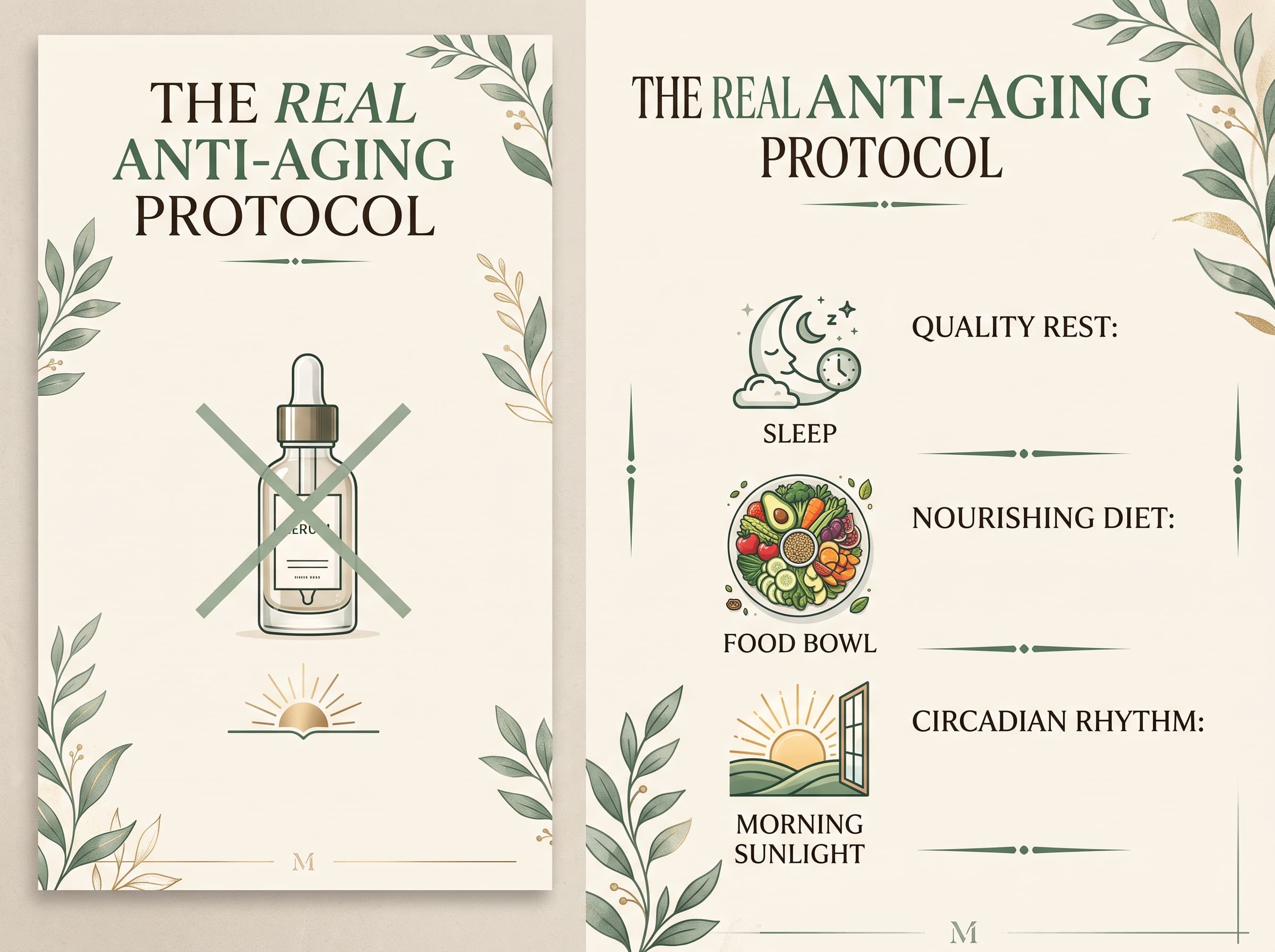
The most effective anti-aging interventions are not sold in bottles. They are lifestyle decisions that the skincare industry has a financial incentive to keep you from making instead of buying products. Here is what the evidence actually shows works most.
The Anti-Aging Secrets the Skincare Industry Doesn't Want You to Know
The global skincare industry was worth approximately $180 billion in 2025. A meaningful portion of that revenue comes from selling the idea that aging is primarily a topical problem with topical solutions, and that the correct response to any visible sign of skin aging is to find and apply the right product.
This is not entirely wrong. Evidence-based topicals including retinol, vitamin C, niacinamide, ceramides, and peptides produce real measurable results in the skin layers they can reach. They are worth using.
But they are operating within a context that the industry rarely acknowledges publicly: the most powerful anti-aging interventions available do not come in bottles. They cost almost nothing. They have stronger evidence behind them than most skincare ingredients. And they address aging at the cellular level rather than at the surface layer where products can reach.
Here is what those interventions actually are.
Secret 1: UV Protection Is the Single Highest-Return Anti-Aging Investment
Before anything else, this number: UV radiation accounts for 80 to 90% of all visible facial aging.
Not genetics. Not stress. Not diet. Not sleep. UV exposure is the dominant driver of the collagen degradation, elastin breakdown, hyperpigmentation, textural changes, and structural changes that accumulate across decades.
The University of Michigan twin study — one of the most influential pieces of research in dermatology — photographed identical twins at age 60 and demonstrated that the twin who had used consistent daily sun protection showed skin that was measurably and visibly younger than their genetically identical counterpart.
Mineral SPF 30 or higher applied every morning, including indoors near windows, including in a car, including on cloudy days when 80% of UV still reaches the skin, is the highest-return anti-aging investment available. An inexpensive mineral SPF used consistently for twenty years outperforms twenty years of expensive serums applied without SPF. Nothing in the product aisle comes close to this level of return.
The industry does sell SPF. But the marketing rarely communicates how dramatically it outperforms the products they are selling alongside it.
Secret 2: Sleep Is the Most Powerful Anti-Aging Protocol That Exists
The body's primary cellular repair mechanism operates during sleep, specifically during slow-wave deep sleep in the first 90 minutes of the sleep cycle and during subsequent deep sleep cycles through the night.
Growth hormone, released primarily during these deep sleep windows, drives collagen synthesis, tissue repair, immune function restoration, and the clearing of cellular waste products including beta-amyloid, the protein aggregate associated with neurodegenerative disease.
The mathematics of sleep deprivation for skin aging is alarming. A single night of four hours of sleep reduces growth hormone secretion by approximately 75% compared to adequate sleep nights. It increases inflammatory markers including TNF-alpha and IL-6 by 25%. It doubles the next day's cortisol, which activates collagenase, the enzyme that degrades collagen. And it impairs the skin barrier repair that occurs specifically during sleep, increasing transepidermal water loss through the following day.
Applied chronically, the cumulative damage is measurable on biological age markers at the cellular level.
A woman who sleeps consistently before 10:30 PM and achieves seven to eight hours of quality sleep is running the most effective anti-aging protocol available every single night. And it is free.
Secret 3: Your Social Life Is an Anti-Aging Prescription
This one consistently surprises people because it sounds like self-help rather than biology. But the evidence is among the most striking in longevity research.
A 23-year longitudinal study by the Yale School of Public Health found that people with positive beliefs about their own aging lived an average of 7.5 years longer than people with negative aging beliefs, after controlling for all health, lifestyle, and socioeconomic variables. The magnitude of this effect is larger than the longevity benefit of not smoking.
Social isolation is independently associated with a 26% increased risk of premature mortality, comparable to the mortality risk of smoking 15 cigarettes daily. The mechanism is measurable: chronic loneliness elevates inflammatory markers including CRP and IL-6 to levels that directly accelerate cellular aging. People with strong social connections show slower telomere shortening, the most direct cellular aging marker available.
Oxytocin, released during positive social interaction, reduces cortisol and promotes the tissue repair processes that slower aging depends on. The dinner with close friends is, from a cellular biology perspective, also an anti-aging intervention.
Secret 4: Strength Training Produces Anti-Aging Effects That Cardio Cannot
After 30, muscle mass declines at approximately 3 to 8% per decade without deliberate intervention. This matters for more than aesthetics.
Muscle tissue is one of the primary sites of insulin-mediated glucose uptake. As muscle mass declines, insulin sensitivity decreases, even in the absence of any dietary change. This progressive insulin resistance produces the elevated baseline insulin that drives inflammation, worsens estrogen dominance through aromatase enzyme activity, and creates the metabolic environment associated with accelerated aging.
Strength training three times weekly builds and maintains the muscle that keeps insulin sensitivity high. It also elevates growth hormone and testosterone, both of which have direct anti-aging effects on skin, bone density, muscle tissue, and metabolic rate. It reduces cortisol in the recovery period, unlike steady-state cardio which elevates it.
Women who strength train consistently in their 40s show physical profiles comparable to women ten years younger on multiple aging markers. The effect is not from taking anything. It is from lifting things.
Secret 5: The Gut Microbiome Determines How Fast Your Skin Ages
Centenarian populations studied for exceptional longevity consistently show greater gut microbiome diversity than age-matched counterparts. This is not coincidence.
As the gut microbiome becomes less diverse with age, a process accelerated by low-fiber processed food diets, chronic antibiotic use, and stress, the systemic inflammatory load increases. This chronic low-grade inflammation, sometimes called inflammaging, directly drives accelerated skin aging through increased collagen breakdown, reduced skin cell renewal, and increased oxidative stress in skin tissue.
The most effective dietary intervention for maintaining microbiome diversity at any age: 30 or more different plant foods per week. This is not 30 servings of the same foods. It is 30 different plant species, counting each distinct vegetable, fruit, grain, legume, herb, and spice as one. The American Gut Project identified this as the single dietary variable most strongly associated with microbiome diversity in a large population study.
Daily fermented food consumption supports microbiome density and diversity alongside the variety intervention. The combination of diversity plus fermented foods produces the most meaningful microbiome benefit available from dietary intervention alone.
What the Industry Wants You to Buy Instead
Retinol, vitamin C, niacinamide, ceramides, peptides — these are evidence-based topicals that produce real results. They are worth including in a skincare routine.
But they work best in a body that is sleeping adequately, managing stress, maintaining muscle mass, eating for microbiome diversity, and wearing mineral SPF every morning. On that foundation, evidence-based topicals produce meaningful additional benefit.
Without that foundation, they are providing a surface solution to a structural problem.
The five interventions above are the foundation. Build that first.
This article is for educational purposes only. Please consult a dermatologist or healthcare provider for personalized guidance on your skincare and anti-aging approach.
More from Her Healthy Empire
The 10-Minute Habit After Meals That May Help Your Blood Sugar and Energy
A short walk after eating may do more than help you feel less sluggish. Research suggests post-meal movement can support the body’s glucose response, while adding an easy source of daily physical activity.
Why You’re Always Tired After 40, Even When You’re Getting Enough Sleep
Feeling exhausted even after a full night of sleep? Discover the overlooked reasons women over 40 may struggle with persistent fatigue, including sleep quality, perimenopause, iron, thyroid health, nutrition, stress, and more.
Period Changes in Perimenopause: What Is Normal?
Perimenopause can change cycle timing, flow, and duration. Some changes are expected, while unusual bleeding still deserves medical evaluation.
The next her healthy empire essay in your inbox.
One careful letter, every Sunday. Free.